What this project is — and isn't
EchoCare was developed as part of a graduate hackathon in HBEH 690 at UNC Gillings School of Global Public Health. The assignment was a rapid ideation and prototyping exercise: identify a public health problem, propose an AI-powered solution, and build a functional prototype — all within one week.
This is a design concept grounded in secondary research and domain expertise, not a product that has been user-tested. I have spent several years studying substance use disorders, opioid use disorder, and health equity in the context of incarceration and reentry — so the problem space is well known to me. But the people most affected by it have not yet had a voice in this design.
"The most important thing missing from this project is the people it's for. EchoCare is a hypothesis, not a solution. Everything below represents my best thinking — and the starting point for real research, not the end of it."
I'm sharing it as a work sample because it demonstrates how I think through a design problem: the questions I ask, the tradeoffs I navigate, and how I move from a research insight to a product idea. The next steps section is where this case study gets most honest about what it would actually take to validate — or invalidate — this concept.
Harm reduction information is fragmented, stigmatized, and hard to reach
People who use drugs (PWUD) face a compounded access problem. The information and services that could keep them alive — naloxone, sterile syringes, medication for opioid use disorder, peer support — exist, but are distributed unevenly, hard to navigate, and wrapped in stigma that makes asking for help feel dangerous.
This isn't an abstract public health statistic. Overdose deaths remain at historically high levels. People in rural areas and those recently released from incarceration face acute service gaps. And even where services exist, the experience of seeking them out is often dehumanizing — encounters with providers who judge, systems that demand paperwork, and a general sense that the healthcare world was not designed with you in mind.
Why AI, and why now?
AI-powered conversational interfaces offer something traditional health resources don't: availability at 2am, no judgment, no waiting room. A person who is actively planning to use and wants to reduce their risk doesn't need a hotline — they need real-time, accurate information in a tone that doesn't shame them for asking.
But AI also introduces real risks in this context. Misinformation can kill. Over-reliance on an automated system can delay someone from getting human help they urgently need. And for a population that has historically been surveilled and criminalized, data privacy isn't a feature — it's a precondition for trust.
The core design question: Can an AI interface be compassionate, accurate, and trustworthy enough to actually help — without replacing the human connection that recovery often depends on?
Four workflows, each mapped to a specific user need
Rather than building a general-purpose health app, I designed EchoCare around four distinct user situations — moments where someone who uses drugs needs a specific kind of support that existing systems fail to provide. Prototypes were built in Canva using AI-generated mockups as a starting reference, then redesigned to reflect the actual intended experience.
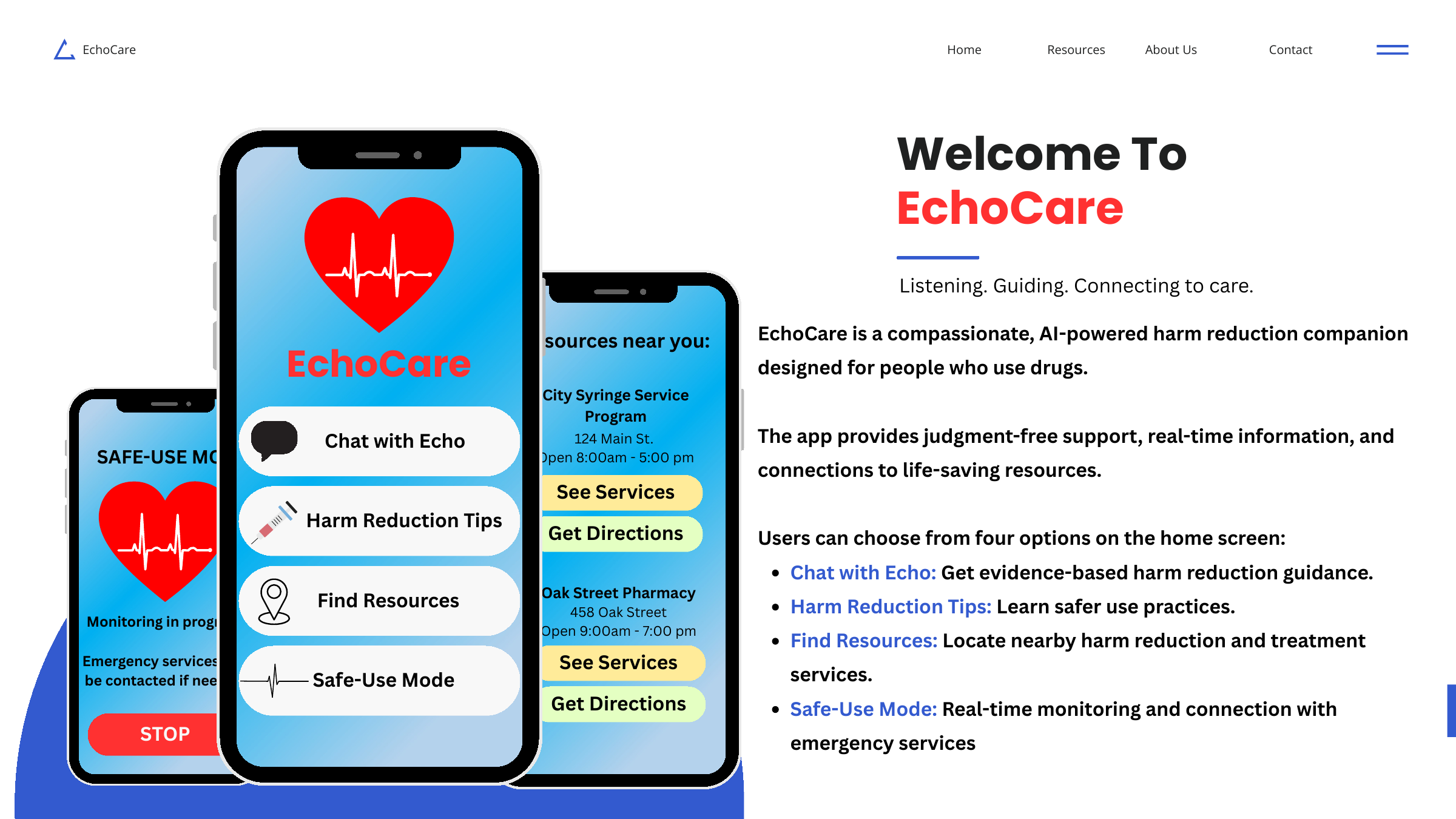
Chat with Echo
A CBT-informed AI chatbot providing judgment-free, real-time harm reduction guidance and emotional support.
Resource Finder
ZIP code or geolocation search connecting users to nearby syringe programs, naloxone sites, MOUD providers, and peer support.
Harm Reduction Tips
Evidence-based, expert-reviewed guidance on safer use practices, overdose response, and infectious disease prevention.
Safe-Use Mode
Wearable sensor integration that monitors vital signs during use and automatically alerts EMS if overdose indicators are detected.
Prototype screens
Home screen & overview
The app's four main entry points, with Safe-Use Mode active in the background and the Resource Finder showing nearby services.
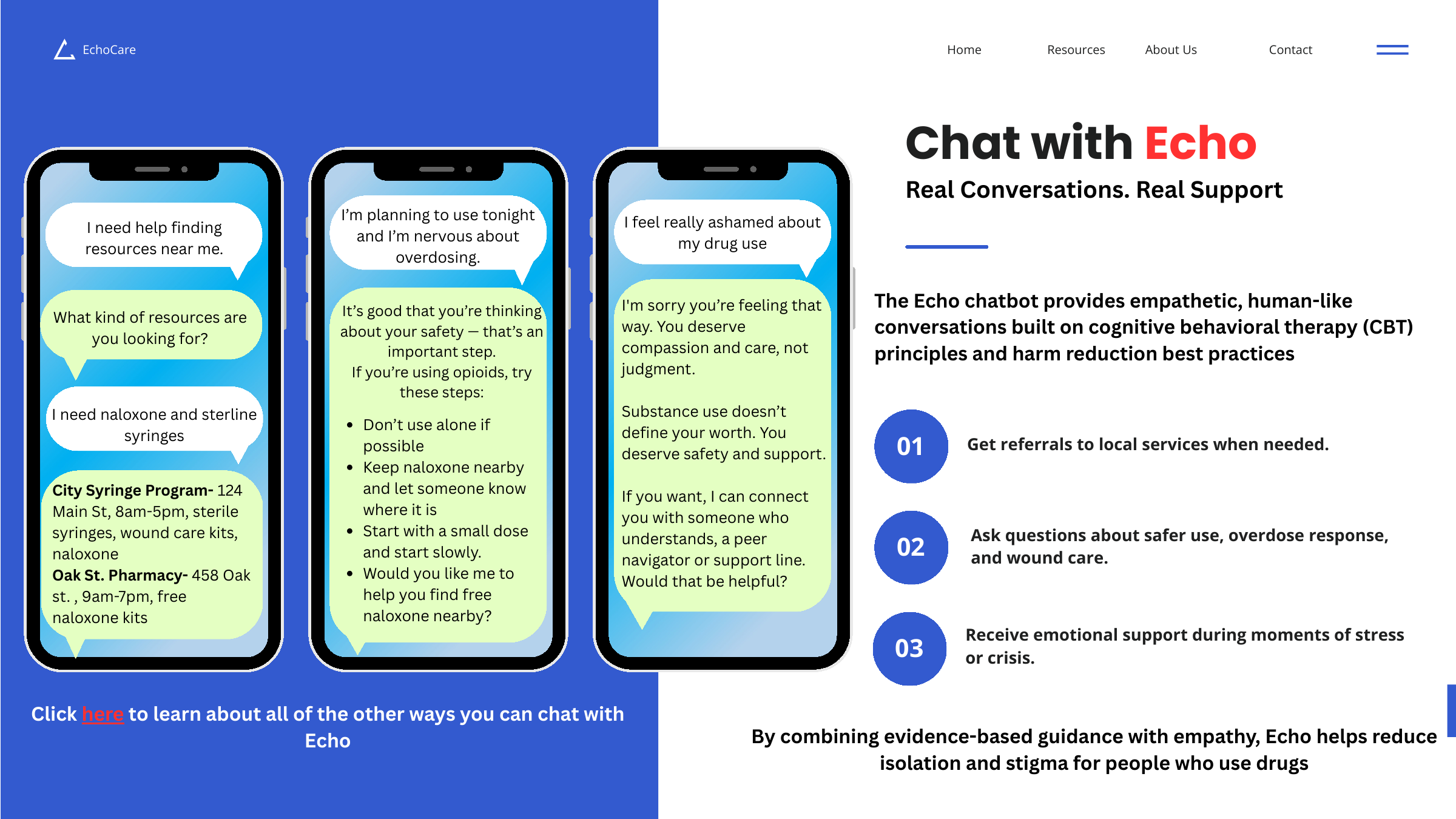
Chat with Echo
Three conversation scenarios: resource-seeking, pre-use safety planning, and shame/stigma support — each demonstrating the chatbot's non-judgmental, harm-reduction-informed tone.
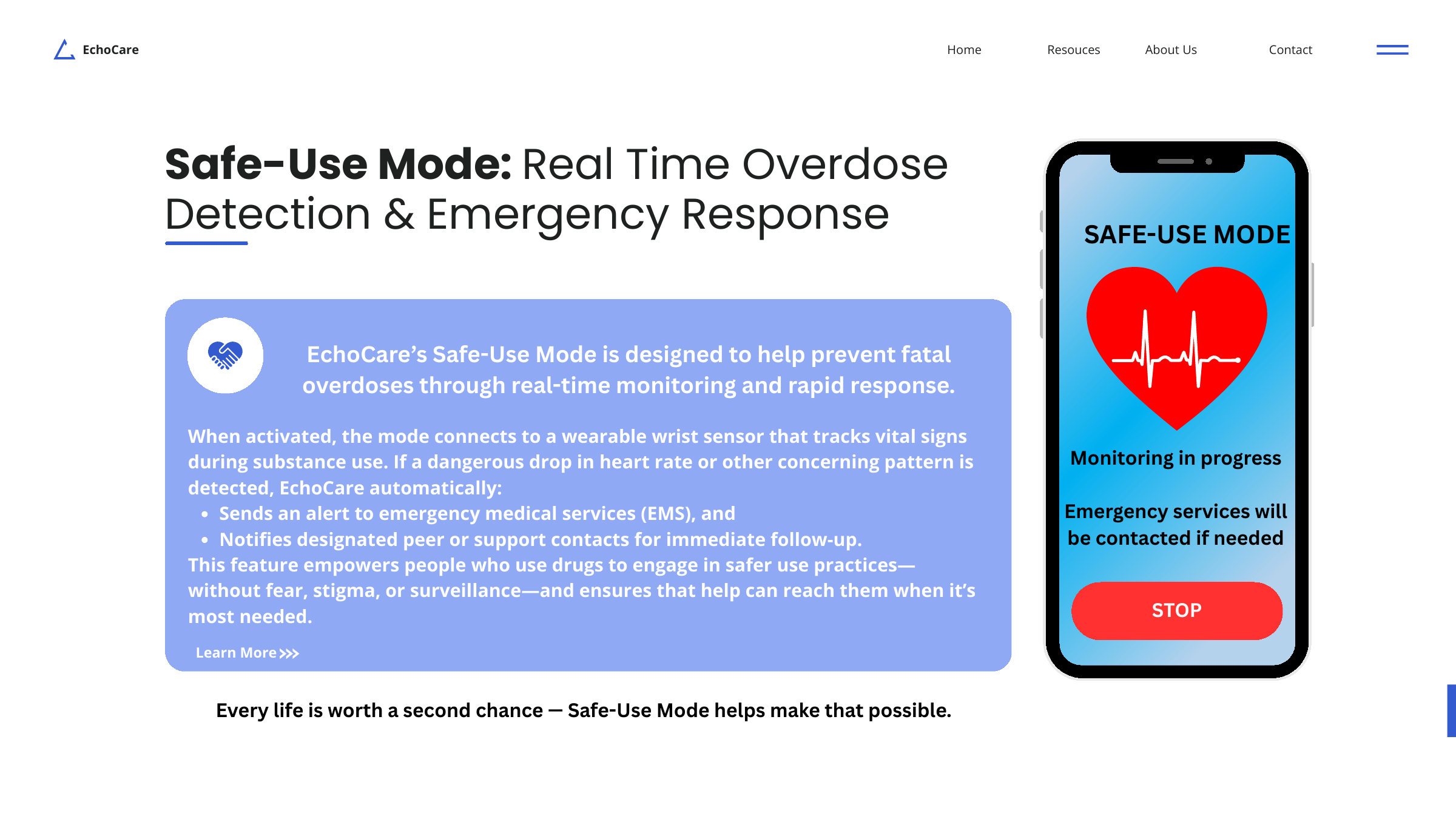
Safe-Use Mode — wearable integration with emergency response trigger
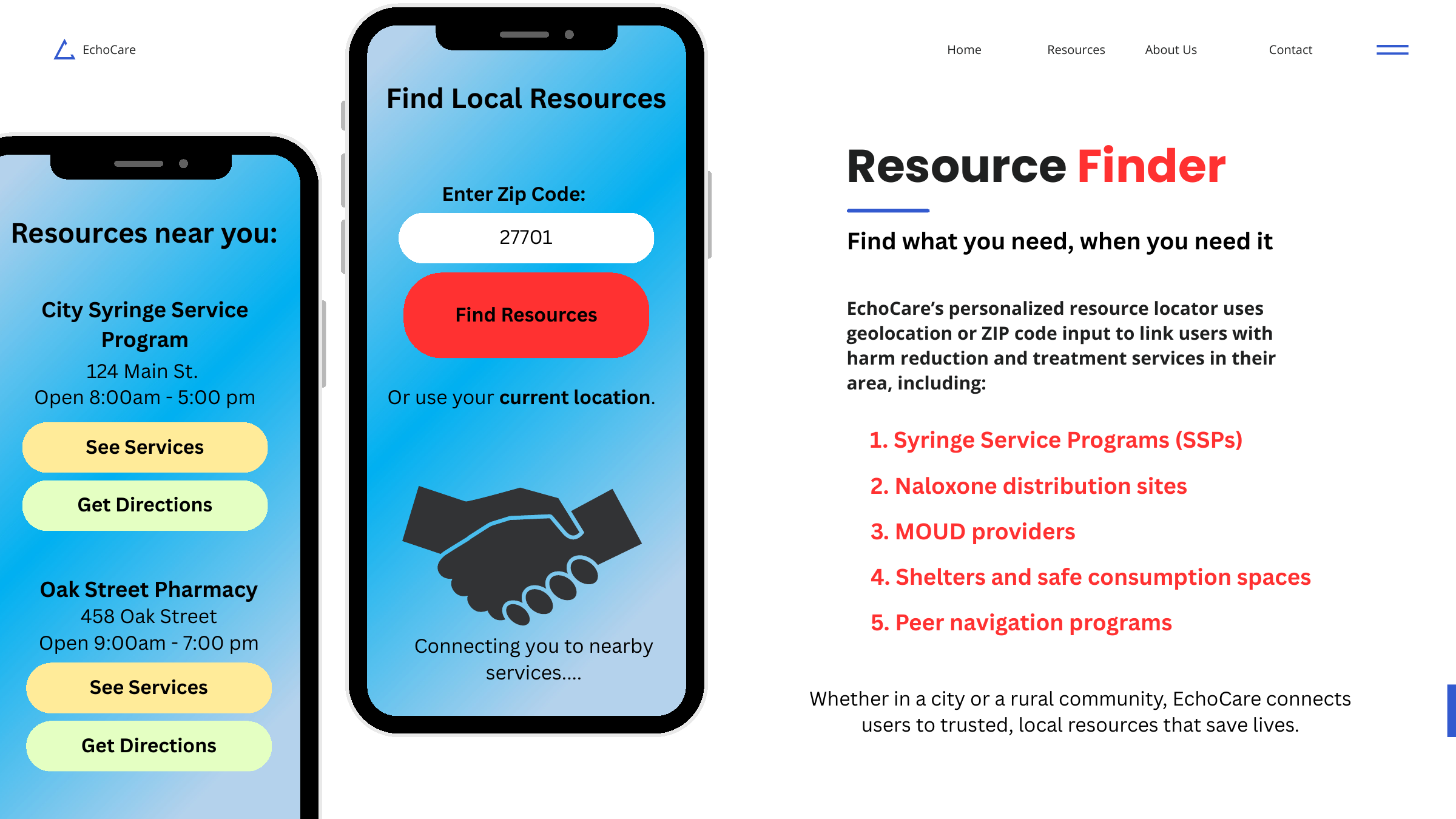
Resource Finder — ZIP code search with real-time local service results
Design decisions worth examining
Why CBT-informed conversation? The chatbot's framework draws on cognitive behavioral therapy principles — not because CBT is the only approach, but because it provides a structured, non-judgmental framework for engaging with distress. This assumption needs user testing: PWUD may have mixed or negative associations with formal therapy language.
Why anonymous by default? Every data interaction is encrypted, with no stored identifiers. For this population, data privacy isn't a footnote — it's a precondition for engagement. People who use drugs have good reasons to distrust any system that could expose their behavior to law enforcement or employers.
Safe-Use Mode: opportunity or overreach? This feature is the most ambitious — and the most ethically fraught. Wearable overdose detection has real potential to save lives. But connecting to emergency services raises serious concerns for a population that often fears police contact. This feature cannot be designed without extensive input from PWUD themselves.
How AI was used in this project
I used ChatGPT to brainstorm feature concepts, generate structured sections of the proposal, and prototype example chat interactions. DALL·E was used to generate initial UI ideas, which I rebuilt manually in Canva. AI was useful for rapid ideation, but required consistent human judgment to ensure accuracy, ethical appropriateness, and contextual sensitivity. The clinical accuracy, tone, and ethical framing all required hands-on revision.
What I learned about designing AI for people in crisis
The trust problem is the design problem
Working on EchoCare made me think differently about what trust means in an AI interface. For most consumer apps, trust is about reliability and data security. For EchoCare's users, trust is existential. If they feel surveilled, judged, or misunderstood, they won't use it. And if they don't use it in the moments they need it most, the product fails regardless of how well-engineered it is.
This pushed me toward a belief I now hold strongly: you cannot design an AI interface for a vulnerable population from the outside in. The assumptions I made about what PWUD need, what language feels safe, what features feel helpful versus invasive — all of those need to be tested with actual users before anything gets built.
The safe-use mode is the clearest example. On paper it sounds like a straightforward life-saving feature. In practice, it might feel like a surveillance device to someone who has been criminalized for the same behavior it's monitoring. I don't know which of those is true. Only user research can answer that.
What using AI in the design process taught me
Using ChatGPT to rapid-prototype this concept gave me firsthand experience with something I think is underexplored in AI product research: the gap between what AI generates and what a context actually requires. The AI could produce plausible-sounding harm reduction content quickly — but "plausible-sounding" in a high-stakes context isn't good enough. Every piece needed fact-checking, and the tone needed adjustment to match how peer harm reduction workers actually communicate.
This made me more interested in the human-AI collaboration question as a research question: not just "does AI help people work faster" but "where does human judgment become essential, and why?" That feels like exactly the kind of question worth asking about AI-powered workflows at scale.
What real research would look like from here
EchoCare is a hypothesis. Before any development investment, it needs a rigorous primary research phase to validate — or invalidate — its core assumptions.
Needfinding interviews with PWUD
Semi-structured qualitative interviews with 8–12 people who use drugs, recruited through syringe service programs and peer navigator networks. Key question: where do you turn when you need harm reduction information right now, and what makes that experience good or bad?
Expert interviews with harm reduction workers
Conversations with peer navigators, syringe program staff, and harm reduction advocates to pressure-test feature assumptions and surface needs I haven't considered.
Concept testing and co-design sessions
Present EchoCare's core concepts — rough sketches, not polished screens — to PWUD and ask them to react. Which features feel useful? Which feel invasive? Safe-Use Mode in particular requires direct input before any further development.
Language and tone testing
A dedicated round of testing focused solely on conversational tone — comparing different phrasings of the same harm reduction information to identify what feels genuinely supportive versus clinical or patronizing.
Assumption mapping and risk prioritization
Map every major assumption in the design and rank by consequence. High-risk assumptions — like whether users trust an AI interface enough to be honest about their drug use — get tested first.
The goal of this research phase isn't to confirm that EchoCare is a good idea. It's to find out whether it is — and if not, to understand what a better idea would look like.
What I'd bring to a UX research role from this project
Designing AI for vulnerable populations requires a different standard of rigor. Good AI product research asks not just "does this work?" but "for whom, in what conditions, at what risk?"
The most important design constraint is trust. In any context where users have reason to distrust technology, trust isn't a feature you add — it's the foundation everything else is built on.
AI tools are useful for generating options, not for making judgment calls. Using ChatGPT to rapid-prototype was genuinely helpful for moving quickly. It was not helpful for determining whether content was accurate or safe. That distinction feels increasingly important as AI becomes embedded in more high-stakes product contexts.